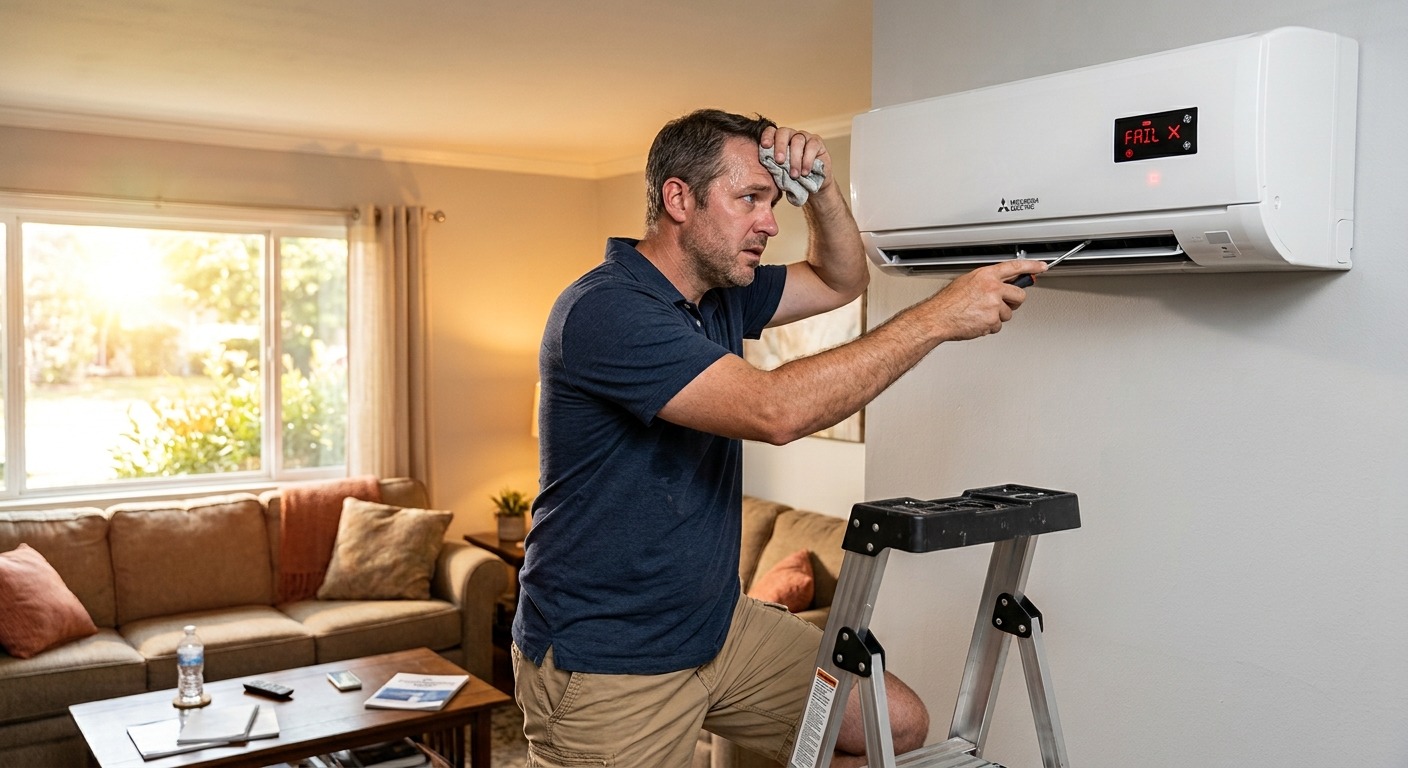
AC Not Cooling? Common Causes, Fixes, and When to Call a Technician
Your AC is running, but the room isn’t getting cool. The problem can range from a dirty filter or incorrect thermostat setting to low refrigerant, frozen coils, duct problems, or an outdoor-unit fault. In Dubai, long AC operating hours, dust, humidity, and high outdoor temperatures can also put additional strain on cooling systems.
The good news is that some causes are easy to identify. Others require professional diagnosis.
This guide explains why your AC may not be cooling, what you can safely check, how to reset it, and when you need AC cleaning or repair.
Why Is My AC Not Cooling?
An AC may stop cooling properly because of restricted airflow, dirty filters or coils, incorrect settings, low refrigerant, frozen evaporator coils, ductwork problems, outdoor-unit faults, or compressor and electrical issues.
The first step is to identify what your AC is actually doing.
| What you’re noticing | Possible cause | What to check |
| AC is running but blowing warm air | Refrigerant, thermostat, outdoor unit, or compressor issue | Thermostat and outdoor unit |
| Weak airflow | Dirty filter, coil, or blocked duct | Filter and vents |
| Ice on the indoor unit | Restricted airflow or refrigerant problem | Turn the system off and arrange an inspection |
| One room is warmer than others | Duct or airflow problem | Vents and air distribution |
| AC runs continuously | Heat load, dirty system, refrigerant or sizing issue | Filters, temperature, and system condition |
| Water leaking from AC | Blocked drain or frozen coil | Arrange an inspection if it persists |
| Outdoor unit isn’t running | Electrical, fan, or compressor problem | Professional inspection |
| Room doesn’t reach the set temperature | Heat gain, duct, capacity, or system fault | Professional assessment |
10 Common Reasons Your AC Is Not Cooling
1. Dirty or Clogged Air Filter
An air filter collects dust and airborne particles before they enter the AC system. When it becomes heavily clogged, airflow can drop, and the system may struggle to cool the room.
A dirty filter can also contribute to coil freezing and reduced efficiency.
What to check:
If your AC has an accessible filter, inspect it according to the manufacturer’s instructions. Clean or replace it when appropriate.
In Dubai, where dust can accumulate quickly, regular AC maintenance can help prevent airflow restrictions.
2. Incorrect Thermostat or AC Remote Settings
Sometimes the AC itself isn’t faulty—the settings are.
Check that:
- The AC is set to Cool rather than Fan or Dry mode.
- The temperature is set appropriately.
- The fan is operating normally.
- The remote has working batteries.
- The thermostat is responding correctly.
If the AC is blowing air but the air isn’t getting cold, changing the temperature alone may not solve the underlying problem.
3. Blocked Airflow or Closed Vents
Your AC may be producing cool air but failing to distribute it properly.
Check whether:
- Supply vents are closed.
- Furniture is blocking vents.
- Return-air openings are obstructed.
- Airflow is noticeably weaker than usual.
If only certain rooms are warm, the problem may involve air distribution or ductwork rather than the main AC unit.
4. Dirty Evaporator or Condenser Coils
AC coils are responsible for transferring heat.
The indoor evaporator coil absorbs heat from indoor air, while the outdoor condenser coil releases that heat outside.
Dust and buildup on these components can reduce heat transfer and make cooling less effective.
If basic filter cleaning doesn’t improve the cooling, the coils may require professional cleaning or inspection.
5. Low Refrigerant or a Refrigerant Leak
Refrigerant is essential to the cooling process. If the system has insufficient refrigerant, it may struggle to remove heat from your home.
Possible signs include:
- Warm air from the vents
- Longer cooling cycles
- Ice forming on the indoor unit
- Reduced cooling performance
Low refrigerant isn’t necessarily something that should simply be “topped up.” If refrigerant keeps becoming low, the system may have a leak that needs to be identified and repaired.
6. Frozen Evaporator Coil
Ice on the indoor AC unit is a sign that something may be wrong.
A frozen coil can be associated with:
- Restricted airflow
- A dirty filter
- Refrigerant problems
- Other system faults
If you notice significant ice, don’t keep forcing the AC to run. Turn the system off and arrange a professional inspection to identify the cause.
7. Ductwork Problems
For central and ducted AC systems, the cooling unit may be working while the conditioned air isn’t reaching the room properly.
Possible duct problems include:
- Air leaks
- Damaged or disconnected ducts
- Poor insulation
- Blockages
- Uneven air distribution
This can explain why one room feels comfortable while another remains warm.
8. Outdoor Unit Problems
For many AC systems, the outdoor unit plays a critical role in removing heat.
If the indoor fan is running but the outdoor unit isn’t operating normally, cooling can be significantly affected.
Potential causes include problems with the:
- Outdoor fan
- Electrical components
- Compressor
- Control system
- Condenser
Avoid opening electrical components yourself. A technician can safely diagnose the outdoor unit.
9. Compressor, Fan or Electrical Fault
A compressor, fan motor, capacitor, control board or other electrical component can fail and prevent the AC from cooling correctly.
These problems generally aren’t suitable for DIY repair.
If the AC suddenly stopped cooling, makes unusual noises, repeatedly trips electrical protection, or has an outdoor unit that isn’t operating, professional diagnosis is appropriate.
10. AC Capacity, Heat Load or Building-Side Problems
Sometimes the AC isn’t necessarily “broken.”
A room may remain hot because of:
- High heat entering through windows
- Direct sunlight
- Poor insulation
- Large areas that require more cooling capacity
- Duct losses
- Incorrect system sizing
- Building-side cooling problems
This can happen when an AC is set to a low temperature, but the room still doesn’t reach it.
AC Not Cooling but Fan Is Running — What Does It Mean?
If your AC is not cooling but the fan is running, the indoor fan may be working while another part of the cooling system isn’t.
Possible causes include:
- Low refrigerant
- Dirty or frozen coil
- Thermostat or control problem
- Outdoor-unit fault
- Compressor problem
- Restricted airflow
A useful first check is to compare airflow and air temperature.
Strong airflow but warm air: the cooling system itself may have a problem.
Weak airflow: First look at the filter, vents, coils, or ductwork.
Indoor fan running but outdoor unit isn’t: the outdoor unit or its controls may require professional inspection.
How to Reset Your AC If It Isn’t Cooling
A reset can sometimes resolve a temporary control or communication issue, but it won’t repair a refrigerant leak, dirty coil, compressor fault, or other mechanical problem.
For a basic reset:
- Turn the AC off using the normal controls.
- Wait briefly before restarting it.
- Restore power using the normal controls provided for your system.
- Set the AC to Cool mode.
- Set an appropriate temperature.
- Allow the system some time to operate.
- If it still isn’t cooling, investigate the underlying problem rather than repeatedly resetting it.
The exact reset procedure can vary between AC brands and models, so check the manufacturer’s instructions when available.
Should I Turn Off My AC If It’s Not Cooling?
If an AC is running without cooling, repeatedly leaving it operating for long periods may not solve the problem.
It’s particularly sensible to stop using the system and arrange an inspection if you notice:
- Ice forming on the indoor unit
- Persistent water leakage
- Unusual electrical symptoms
- A burning smell
- The outdoor unit isn’t operating correctly
- The system repeatedly trips electrical protection
If there are no obvious warning signs but the AC simply isn’t cooling, basic checks such as the thermostat, filter, and airflow can help identify the next step.
How Do I Make My AC Cold Again?
Start with the simple checks:
- Confirm the AC is in Cool mode.
- Check the temperature setting.
- Check the remote batteries.
- Inspect the accessible air filter.
- Make sure vents aren’t blocked.
- Check whether airflow is normal.
- Check whether the outdoor unit appears to be operating.
- Look for visible ice or water leakage.
- Try one normal reset.
If the AC still isn’t cooling, the problem may require cleaning, repair, or professional diagnosis.
Why Is My AC Still Not Cooling After Cleaning?
Cleaning the filter or visible parts of an AC doesn’t necessarily fix every cooling problem.
Your AC can remain warm after cleaning if it has:
- A refrigerant leak
- Low refrigerant
- A frozen evaporator coil
- A compressor problem
- A thermostat fault
- An outdoor-unit problem
- Duct leakage or blockage
- Incorrect system sizing
- A building-side cooling issue
So if your AC is not cooling even after cleaning, don’t assume that more cleaning will solve it. The system may need a proper diagnosis.
What Can You Safely Check Yourself?
Before calling a technician, you can usually check a few basic things.
Safe basic checks
- AC mode
- Temperature setting
- Remote batteries
- Accessible air filter
- Blocked vents
- Unusual changes in airflow
- Whether the outdoor unit appears to be operating
- Visible ice or water leakage
What you shouldn’t attempt yourself
Avoid working on:
- Refrigerant
- Electrical panels
- Compressors
- Capacitors
- Internal electrical components
These require appropriate tools, knowledge, and safety procedures.
AC Cleaning vs AC Repair: Which Do You Need?
Not every cooling problem requires the same service.
| Problem | Service that may be required |
| Dirty filter | Filter cleaning/replacement |
| Dusty coils | AC cleaning |
| Restricted airflow | Cleaning or airflow inspection |
| Low refrigerant | Refrigerant/leak diagnosis and repair |
| Frozen coil | Diagnosis and corrective repair |
| Compressor fault | AC repair |
| Electrical fault | AC repair |
| Persistent water leakage | Drain/system inspection |
| Duct leakage | Duct inspection/repair |
| Building cooling issue | Building management/provider |
The symptoms alone don’t always identify the exact fault, so persistent problems should be professionally diagnosed.
Could Dubai’s Heat or Building Cooling System Be the Problem?
Dubai’s high outdoor temperatures place substantial cooling demand on air-conditioning systems. An AC that works normally during milder weather may struggle when outdoor heat and indoor heat gain are high.
The type of cooling system also matters.
Split AC
Individual indoor and outdoor units can develop problems involving filters, coils, refrigerant, fans, compressors or controls.
Central or ducted AC
Cooling problems can involve the main system as well as ducts, vents, and air distribution.
District cooling
Some Dubai properties use district cooling rather than a conventional individual cooling system.
If several rooms suddenly lose cooling, the indoor equipment appears normal, or other residents are experiencing a similar issue, the problem may be related to the building or district cooling system.
In that situation, contacting building management or the relevant cooling provider may be more appropriate than immediately arranging an individual AC repair.
When Should You Call an AC Technician?
Professional inspection is recommended when basic checks don’t restore cooling or when you notice signs of a more serious fault.
Contact an AC technician if:
- Your AC continues blowing warm air.
- The system repeatedly freezes.
- Refrigerant may be low.
- The outdoor unit isn’t operating.
- Water continues leaking.
- The compressor or fan appears faulty.
- Cooling is very uneven.
- The AC runs continuously but can’t reach the desired temperature.
- You repeatedly need to reset the system.
- The AC has stopped cooling suddenly.
For persistent cooling problems, finding the underlying cause is more useful than repeatedly resetting or cleaning the unit.
Frequently Asked Questions
Why is my AC not cooling but the fan is running?
The indoor fan can continue running even when the cooling system has a problem. Possible causes include low refrigerant, restricted airflow, frozen coils, thermostat problems, outdoor-unit faults, or compressor issues.
Why is my split AC not cooling but the fan is running?
Check the cooling mode, temperature setting, and filter first. If airflow is normal but the air remains warm, the problem may involve refrigerant, the outdoor unit, compressor, or another cooling component.
Why is my AC not cooling even after cleaning?
Cleaning can improve airflow but won’t fix problems such as refrigerant leaks, compressor faults, thermostat problems, duct issues, or building-side cooling problems.
How do I reset my AC if it isn’t cooling?
Turn the AC off using its normal controls, wait briefly, restart it, select Cool mode, and check the temperature setting. If cooling doesn’t return, the underlying fault may require professional diagnosis.
Should I turn off my AC if it isn’t cooling?
If the system is freezing, leaking water, showing electrical warning signs, or the outdoor unit isn’t operating properly, it’s better to stop using it and arrange an inspection rather than continually running it.
How do I make my AC cold again?
Check the cooling mode, temperature setting, filter, vents, and airflow first. You can also try a normal reset. If the AC still doesn’t cool, it may need cleaning, repair, or professional diagnosis.
Why is my AC running continuously but not cooling?
Continuous operation can result from restricted airflow, dirty coils, low refrigerant, high heat gain, duct problems, incorrect sizing or a mechanical fault.
Why is my AC set to 20°C but the room is still hot?
A low thermostat setting doesn’t guarantee that the room can reach that temperature. High outdoor heat, poor insulation, heat entering through windows, duct problems, insufficient capacity, or an AC fault can all prevent the room from reaching the setpoint.
Can Dubai’s heat affect AC cooling performance?
High outdoor temperatures increase the cooling load on an AC system. However, an AC that consistently fails to cool properly may have an underlying maintenance, airflow, refrigerant, mechanical, or building-side problem.
How do I know whether I need AC cleaning or AC repair?
Cleaning may help when dust and restricted airflow are the main problems. Persistent warm air, refrigerant issues, freezing, compressor faults, electrical problems, or recurring leaks generally require diagnosis and potentially repair.
Need Help With an AC That Isn’t Cooling?
If basic checks haven’t restored cooling, professional diagnosis can help identify whether the problem is related to AC cleaning, refrigerant, airflow, electrical components, the compressor, ductwork, or the building cooling system.
For persistent cooling problems, arrange an AC inspection or repair in Dubai rather than continuing to run a system that isn’t performing properly.
Get Free Estimate!
Request A Quote


Need a Service? Feel Free to Contact Us.
We are available 24/7. Contact us anytime for fast, reliable, and timely services.